The Product
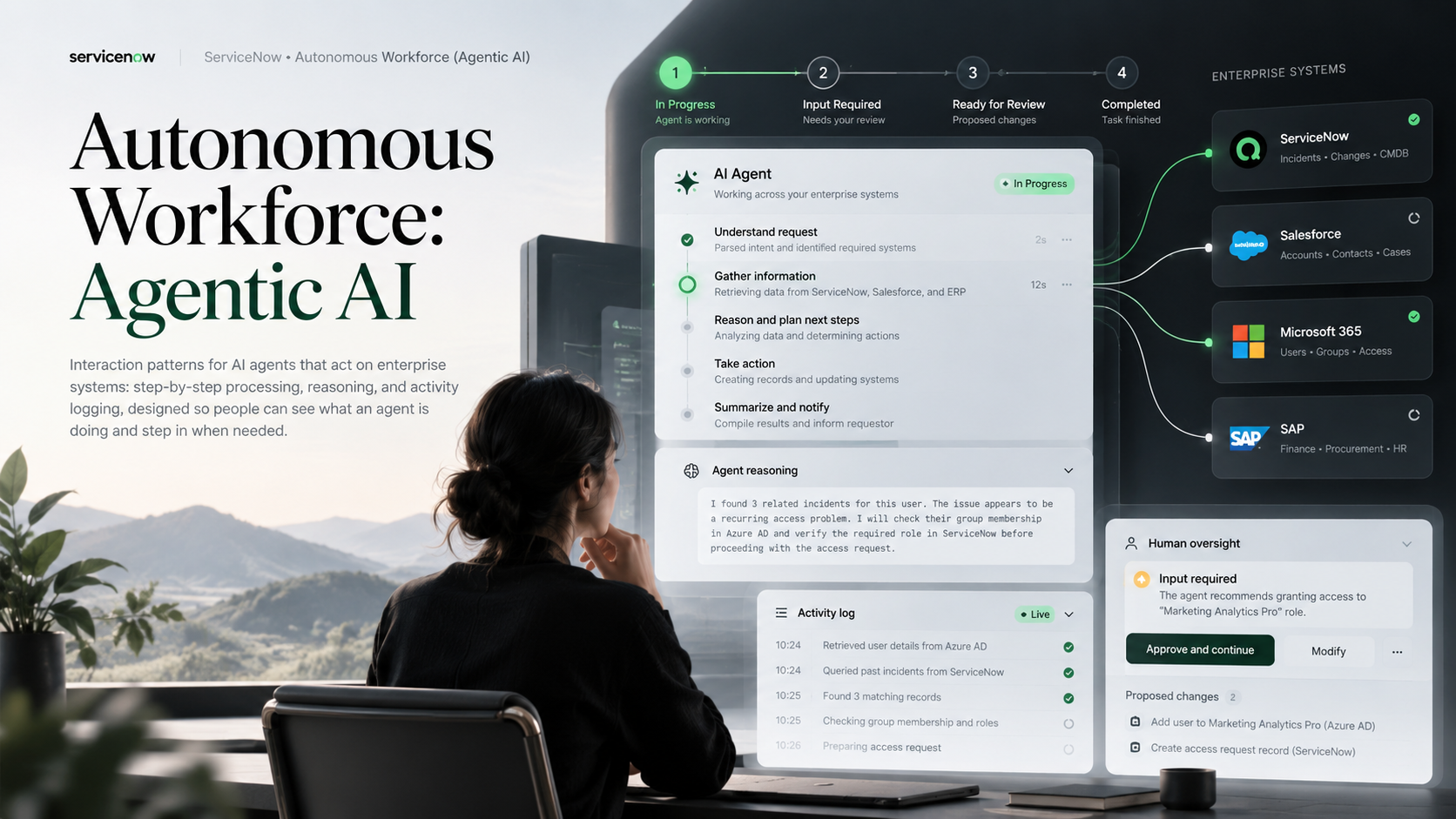
Autonomous Workforce is ServiceNow's agentic AI initiative: AI that doesn't just draft a reply, but plans a multi-step resolution and executes the parts it can. It builds on the foundational Now Assist patterns and extends them into workflows where the AI is taking actions, not just generating text.
Readers who want the product context can learn more on ServiceNow's Autonomous Workforce page.
My Role
I design the core interaction patterns for the agentic experience: how a step-by-step plan is surfaced, how the agent's reasoning is exposed, and how the work it does is logged for the people accountable for the outcome. The patterns are designed once at the platform layer and used by product teams shipping agent capabilities on top.
Results
The patterns are in production across ServiceNow's agentic capabilities and were used in product demonstrations at NVIDIA GTC 2026. Customer reports include ~70% reduction in mean time to resolve for AQL clients using the autonomous resolution-plan workflow, and ~35% faster resolution at Lenovo on cases that combine AI summarization with the resolution-plan generation flow.
Background
An AI that writes a draft is a content tool. An AI that takes actions is a system. The shift changes what the interface has to do. With a draft, the person reads it and decides whether to send it. With an agent, the person needs to see the plan, the step it's on, what evidence it used to decide, and where to break in if something looks off. The design problem moves from "review one output" to "supervise a process."
When I started on this, the agentic capabilities were promising in demos and unclear in real workflows. Operators wanted to know what the agent was about to do, not just what it had just done. They wanted the equivalent of a runbook: a visible plan they could trust, intervene in, and audit later.
Approach
Three working assumptions shaped the patterns:
- Steps before sentences. Plans are easier to trust as discrete, named steps than as paragraphs. Each step has a clear before-state, action, and after-state.
- Reasoning is summary, not transcript. Showing every token the model produced doesn't build trust; it hides intent. The patterns expose why the agent chose a step, not the full chain of thought.
- The log is the record. Once an agent acts, what it did needs to be there in plain text for the person who comes back later. The activity log is part of the design, not an afterthought.
Patterns
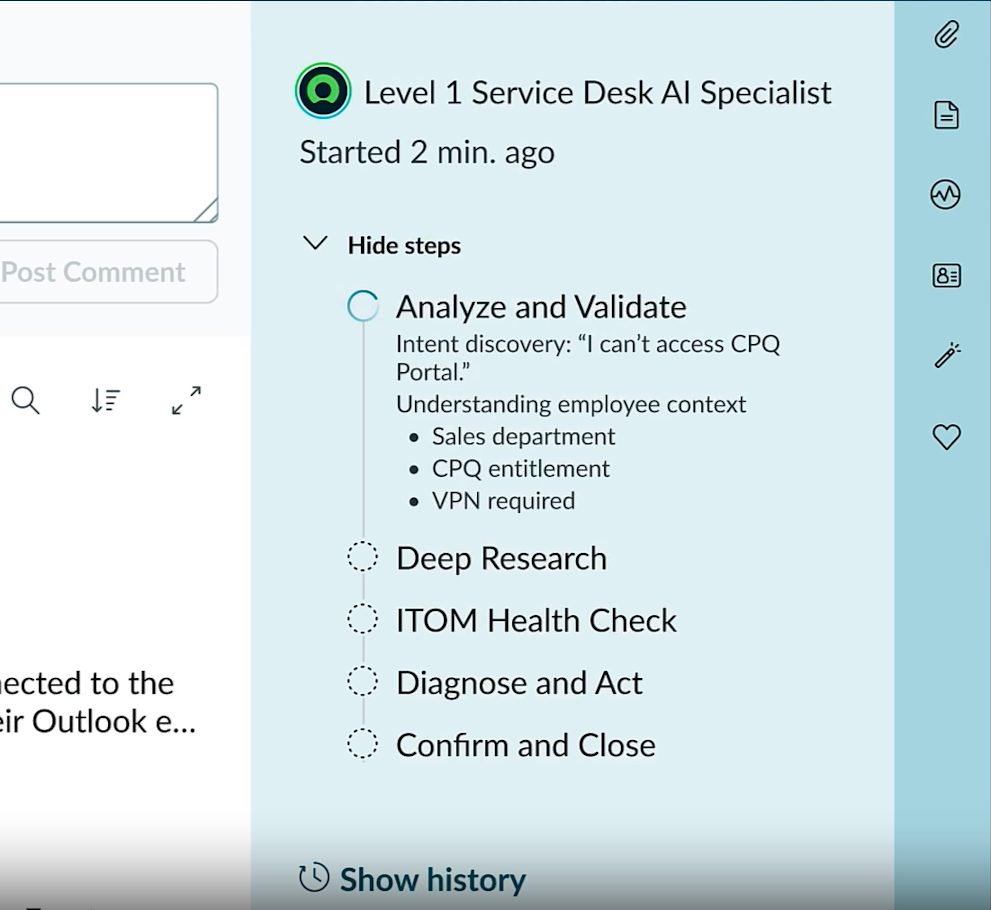
Step-by-step processing
A plan view that breaks an agent's work into discrete steps, each with a status (planned, running, completed, failed, needs review). Steps can be expanded for detail, paused, edited, or handed off to a person. The pattern is designed to scale from a two-step plan to a much longer one without changing the basic mental model.
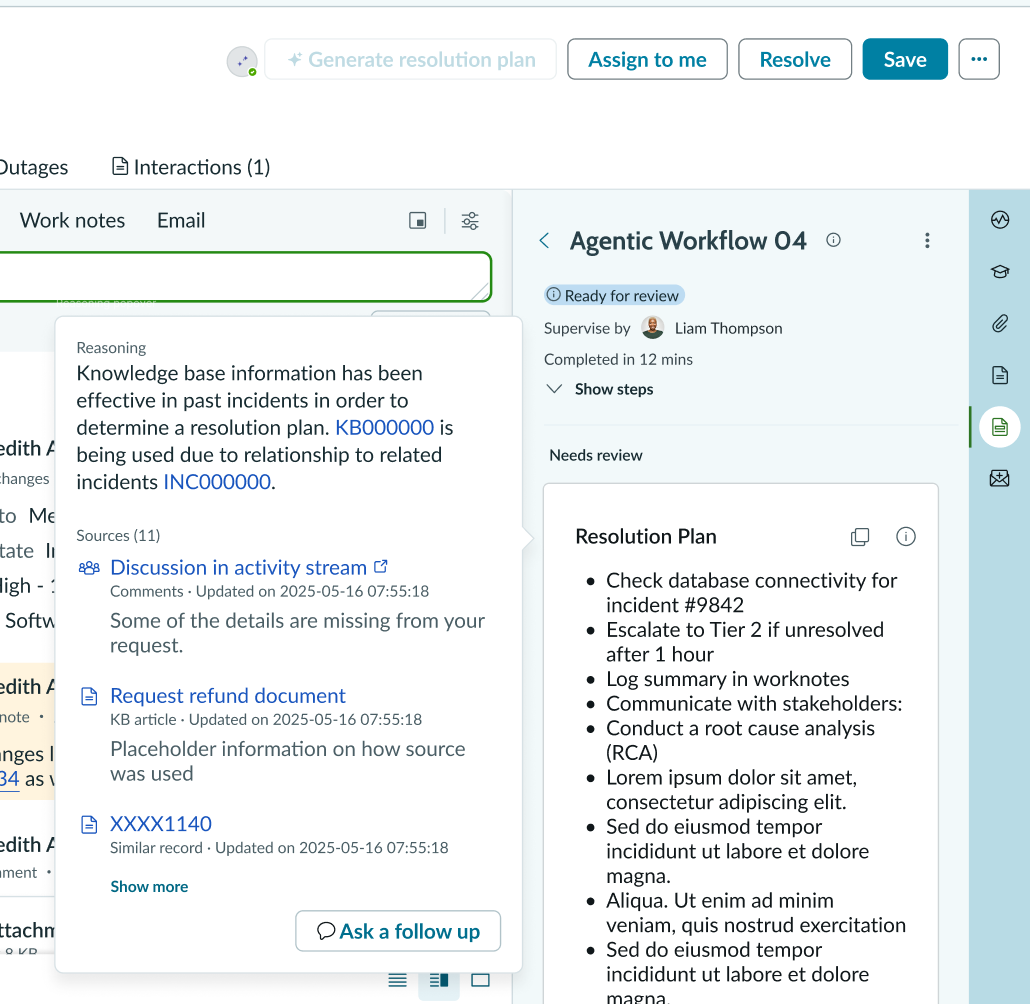
Reasoning surface
For each step, a short rationale: what the agent decided, which inputs influenced it, and how confident the underlying signal is. The reasoning is framed as supporting context, not as a verdict, designed to help a person decide whether to accept a step, not to imply the system already has.
Activity log
A canonical, append-only record of agent actions across a case or workflow: actions taken, records changed, results produced, and which steps were human-authored versus agent-authored. The log is the audit surface for the person doing the work and for whoever reviews it later.
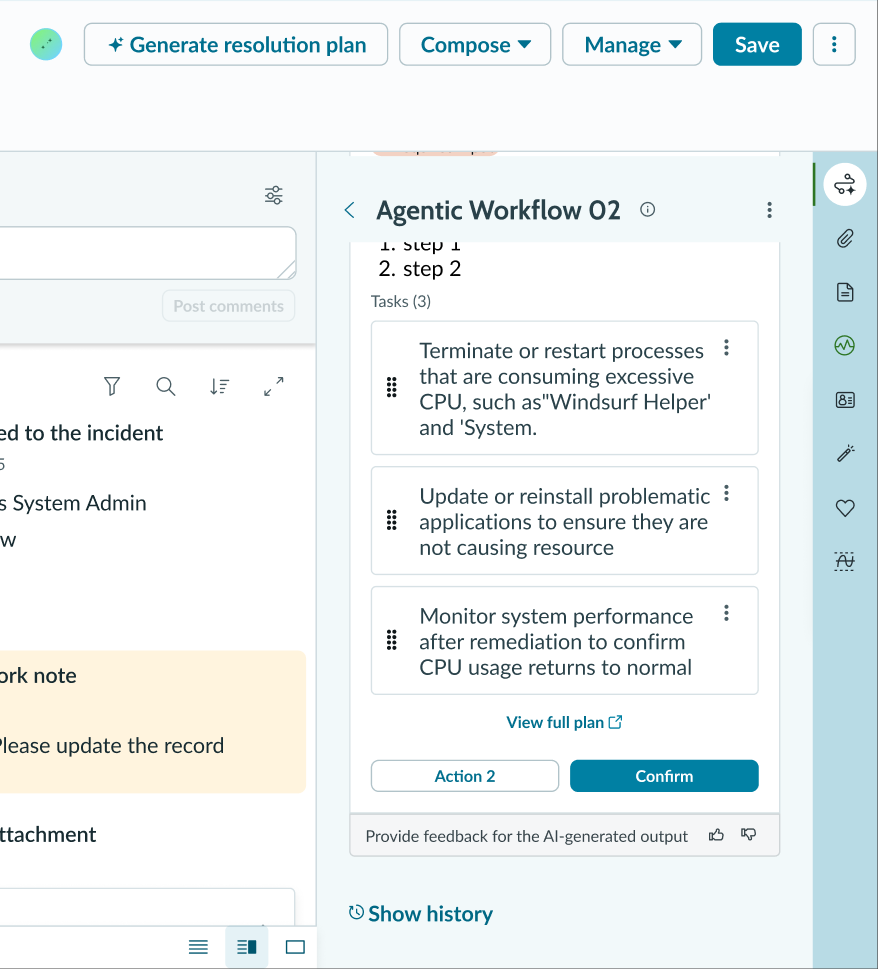
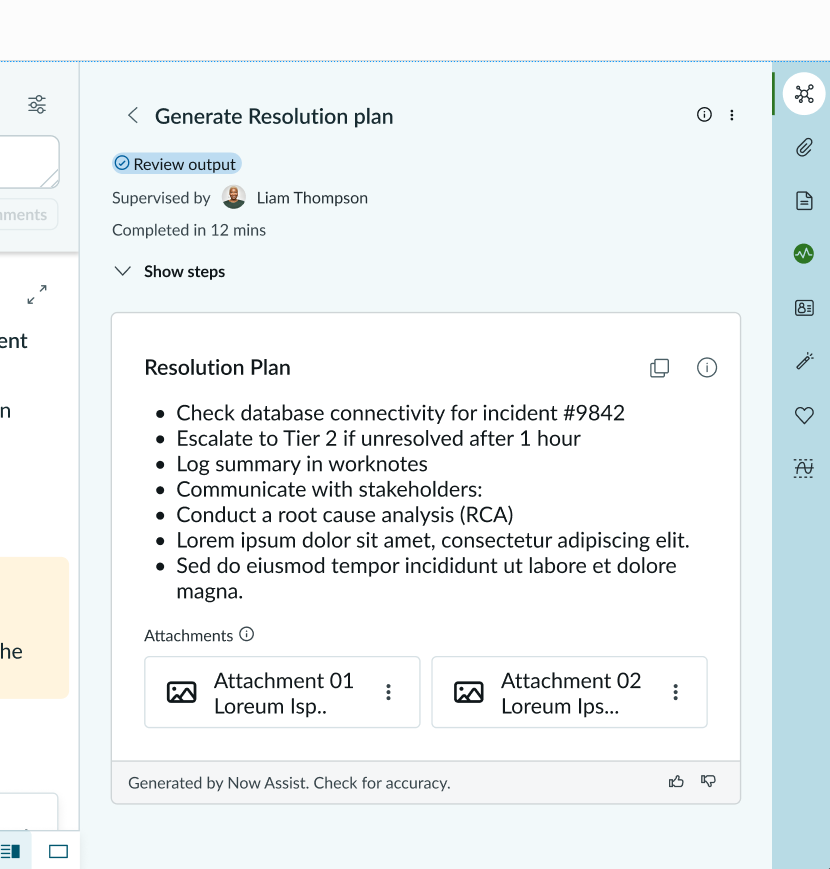
Resolution Plan Generation
A specific application of the patterns above: an AI proposes a multi-step plan to resolve an incident or case, executes the steps it can autonomously, and surfaces the ones that need human intervention. This is the workflow currently driving the published customer outcomes around MTTR reduction.
How the patterns fit together
Each pattern stands on its own, but the combination is the point. A person looking at an agent's work sees the step (what), the reasoning (why), and the log (what's already happened). The same three surfaces appear regardless of which product team is shipping the agent capability, so an operator who learns the patterns in one product can use them anywhere on the platform.
Where it shows up
The patterns ship in ServiceNow's agentic AI capabilities and are visible in the product demonstrations of Autonomous Workforce at NVIDIA GTC 2026. They're documented in the design system so product teams adding new agent capabilities can adopt them without redesigning the surface.
Process artifacts