The Product
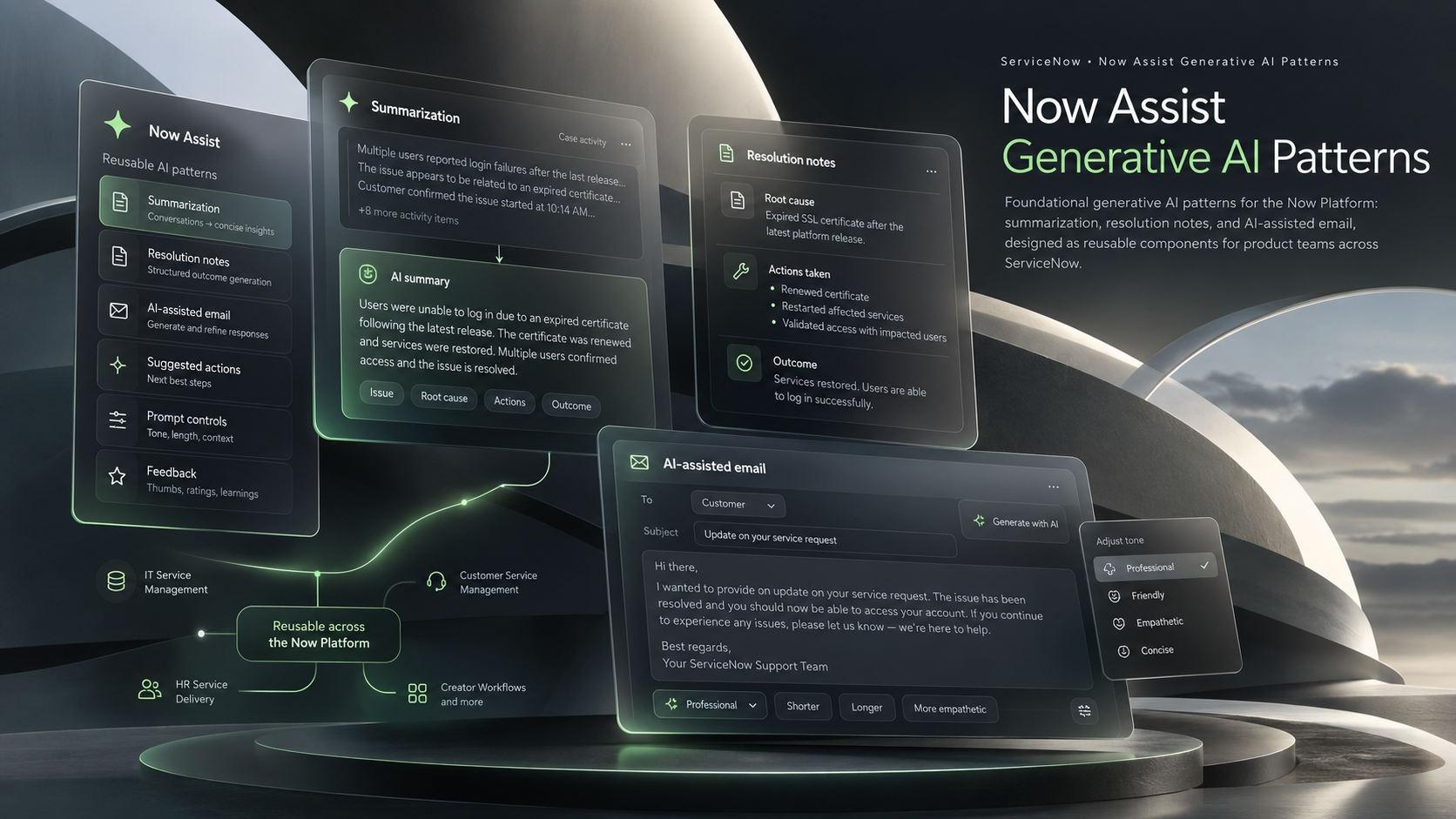
Now Assist is ServiceNow's generative AI surface, layered into the workflows people already use across ITSM, customer service, HR, and other product lines. The opportunity in early 2023 was to take new model capabilities and translate them into everyday actions inside cases, records, and conversations without disrupting the way agents already worked.
My Role
I led design on the foundational interaction patterns, working alongside a product manager and an engineering team building the platform AI services. My focus was the experience layer: how a summary, a draft reply, or a suggested resolution should appear inside an existing workflow, how a person reviews and edits it, and how the same pattern can be reused by other product teams without each one rebuilding it.
Results
The first set of patterns shipped in the Vancouver release in September 2023 as ServiceNow's first generative AI capabilities. They were picked up across multiple product areas, and customer reports surfaced concrete time savings: ~55% less time spent on case documentation at BT Group, and similar reductions reported at other enterprise customers using the same patterns.
Background
Generative AI in enterprise software is a different problem from generative AI in a chat app. The same person works the same case all day, every day. They have a queue, an SLA, and a manager looking at their close rate. Anything new that arrives in their flow has to earn its place there: fast to skim, easy to correct, and obviously safe to act on. The framing I started with was less "what can the model do" and more "what is a useful thing to put in front of an agent in the middle of their work."
A second constraint shaped the work from the start: ServiceNow has many products. If each one designed its own way to show an AI-generated summary, the platform would fragment quickly. So the patterns needed to be reusable: a small set of well-defined behaviors that any product team could pick up and apply consistently.
Research
I started by sitting with case agents and watching the actual cadence of how they open a record, scan history, write notes, and close. A few things stood out:
- Most of the time on a case is reading, not writing. A long case has dozens of comments and customer messages; agents skim to rebuild context.
- Agents are accountable for what they say. Anything auto-generated needed an obvious way to read it, change it, and decide to send it.
- Trust is built incrementally. The first time someone sees a generated summary, they read every word. The fifth time, they glance. The interaction has to support both.
These observations set the bar for the patterns: each one had to be glanceable when the agent already trusted it, and inspectable when they didn't.
Patterns that shipped
Record / Case Summarization
A compact summary surfaced at the top of long cases, with a clear visual distinction between the generated text and the underlying activity stream. Agents can expand the source, regenerate with a different framing, or copy the summary into a handoff note. The pattern is built so any product (incident, change, HR case, customer service case) can drop it in with consistent behavior.
Resolution Notes
When a case closes, an agent typically writes a short note describing what happened and why. The pattern drafts that note from the case history and presents it as an editable proposal, not a final answer. The interaction emphasizes the edit step: it's framed as a starting point that the agent owns, not a system output that the agent rubber-stamps.
AI-Assisted Email
For customer-facing replies, the pattern generates a draft email in the agent's voice and tone, grounded in the case context. The same review-and-edit framing applies. The tricky part of this one was tone: an enterprise reply needs to sound like the agent, not the model. The pattern includes light controls for length and formality.
Agentic Resolution Plan
An extension of the foundational patterns into multi-step agent workflows: an AI proposes a plan, executes the steps it can, and surfaces the ones that need a human. This was the bridge between assistive AI and agentic AI, and the patterns I'd defined for review-and-edit carried directly into how a person oversees an agent's plan.
How the patterns get reused
The patterns are documented as a small set of components and interaction rules in Figma and in ServiceNow's design system. Product teams adopting them follow a short intake: describe the use case, identify the data the AI sees, and confirm the review surface. Then they build on top of the existing components rather than designing from scratch. The intent was to make consistency the path of least resistance.
What changed for customers
Enterprise customers using Now Assist have reported measurable time savings in case work. Published examples include BT Group (≈55% reduction in documentation time), EY (≈100,000 hours/year saved across teams using summarization and resolution notes), Nexon (CSAT moving from 89% to 96% on cases using AI-assisted resolution), and Deloitte Canada (≈20% productivity improvement). These outcomes are published by the customers themselves and tracked by ServiceNow's product team.
Process artifacts
Looping prototype walkthrough showing reusable Now Assist patterns for summarization, resolution notes, and AI-assisted email inside ServiceNow workflows.

